Anthony Norris GrovesPark donor, Philanthropist. Magistrate.1826 to 1905
January 20, 2026
Stan Norman TannerPark donor, Philanthropist. Magistrate.1826 to 1905
September 22, 2026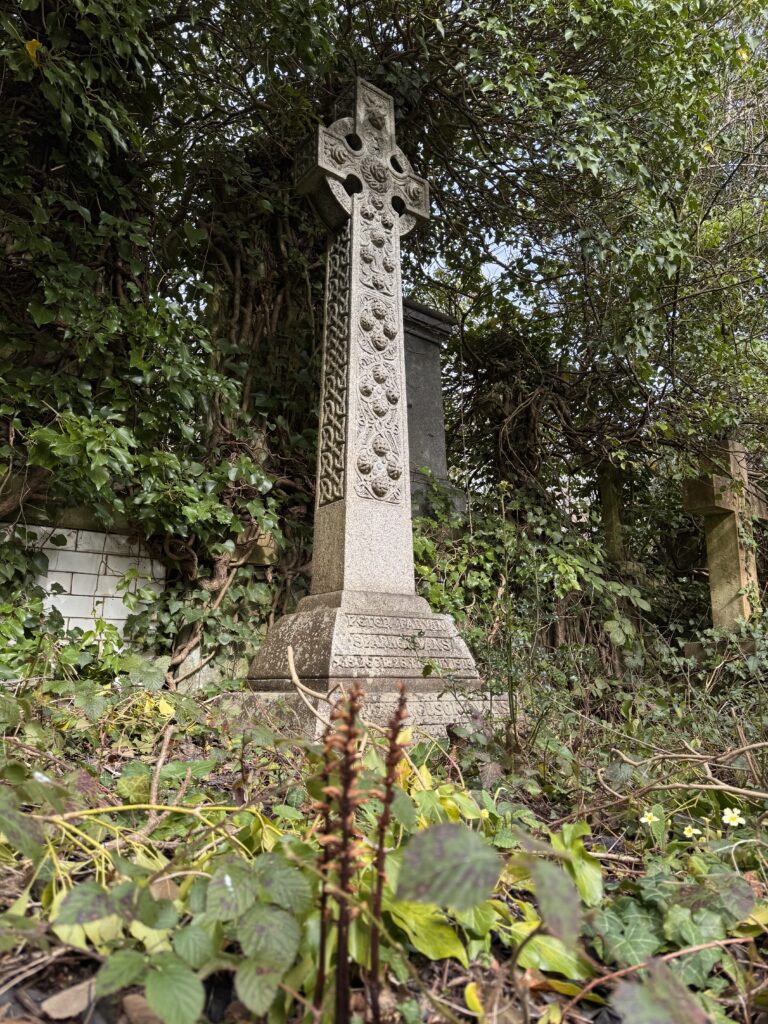
Early life
Peter was born on 19th December 1826 in Ashburton, Devon to Father Lavington and Mother Marys. He had a brother Jonathan.
He married Jane Ferguson in 1861 and went on to have 6 children, Isabelle, Mary, William, F, Hanley & Dorothy.
Career
Peter was a long-serving Bristol Magistrate, sitting on the bench for about 24 years, before withdrawing in later life because of deafness.
He was a major local employer through the Avonside Tannery on Feeder Road and known for his involvement in charitable work in the city. The Evans brothers, as partners in the tannery, were also members of the Committee for Promoting the Better Housing of the Poor. He made a donation of land which was intended to provide a recreation ground for the industrial workforce of St Philips Marsh. The land itself occupied an area of former arable land once known locally as the Bean Field. The brothers, in a letter to the Lord Mayor Sir Robert Henry Symes dated 16 July 1902, outlined their vision for this new park:
Dear Lord Mayor,—My brother and I have much pleasure in sending the enclosed for acceptance of the Town Council on behalf of the city of Bristol.—I am, yours truly, Jonathan L. Evans.
Considerable experience with day and Sunday schools, and especially our connection with the working classes in some of the most populous parts of the city, have shown the great need there is for more open spaces, and this fact induces us to offer to the Town Council about seven acres of land in St. Philip’s Marsh, adjoining the river Avon, for pleasure grounds and play-fields. We do not wish to hamper the gift with unnecessary restrictions, but constant observation and experience in school treats have shown us the very great inconvenience to which large numbers of school children are exposed when taken to a considerable distance where there is no shelter from the weather. We suggest, therefore, the erection at one end of the play-fields of suitable accommodation for women and girls, and a gymnasium for men and boys at the other end, with appliances for large and numerous tea gatherings. It is painful to observe in many of the courts and lanes of the city an almost entire absence of flowers. The erection indicated above might be used during the winter months as shelters for cottage window plants. The proximity of the land to the river tends to make it convenient for large open-air swimming baths or bath, and as possibly the dam across the river at Totterdown may be carried out, there would be alongside the land a fine stretch of water from that point to Netham suitable for boating. The disused towing path could be planted with quick growing trees, such as poplars, plane, and chestnut, and if provided with seats would furnish a pleasant walk or rest for those who most need it. As this position (from the increase of the city) may at a future time become more valuable, it may be desirable to exchange it for a more advantageous site of larger extent, or it may possibly be enlarged by the addition of adjoining land. We wish to make one condition, and that is that a permanent notice should be legibly placed stating that this land is given particularly for the use of the old, the young, and the infirm, to remain for ever non-political and undenominational, but free to all.
— P. F. Sparke Evans and Jonathan L. Evans (letter dated 16 July 1902)
Sparke Evans Park becomes a reality.
In their reporting of the donation, the Western Daily Press suggested the names Evans Coronation Park and Evans Gardens, influenced by the naming of Greville Smyth Park the day prior (July 17).The gift was formally acknowledged by the city council later that month, with councillors voting to convey their thanks to the donors.
The Bristol Sanitary Committee subsequently recorded that the council had accepted the land for use as a recreation ground, and arranged a site visit in August 1902. After the gift was accepted, the corporation undertook the park's initial laying-out and added basic amenities.
Death
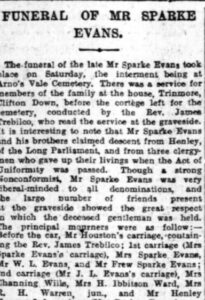
Peter Fabyan Sparke Evans died in July 1905 and was buried at Arnos Vale Cemetery.
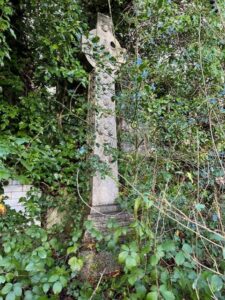
His memorial is a splendid granite celtic cross After his death, civic leaders referred in public proceedings to his long service as a city magistrate and to the parkland gift. The park's development was among a broader late-19th- and early-20th-century programme in which Bristol created or adopted multiple municipal parks, alongside sites such as St George Park, Gaunts Ham Park, and Fishponds Park. He has a splendid celtic cross on the Long Path - W3W amber.dates.books or
His legacy lives on
In 1910, the development of the park was accelerated through unemployment relief schemes coordinated by the Bristol Distress Committee. To alleviate local poverty, the committee employed hundreds of men in four-day shifts to level the ground at Sparke Evans Park and improve Conham Road, funded partly by a Lord Mayor's appeal.
In a May 1910 report regarding the relief works, the Bristol Distress Committee stated that 633 men had been employed on projects including the leveling of Sparke Evans Park and improvements to Conham Road. By the mid-1920s, the park was described in the local press as a valued place of respite for the industrial workforce of St Philip's Marsh.
It was divided into a pleasure garden with herbaceous borders and a dedicated sports area for cricket and football. The park also historically had a strong reputation for the quality of its rosebeds. This has been linked to the park's proximity to the railway sidings at St Philip's Marsh depot, suggesting soot reduced the incidence of rose black spot during the steam era.
Vandalism
As the houses locally disappeared and industrial units took their place, the p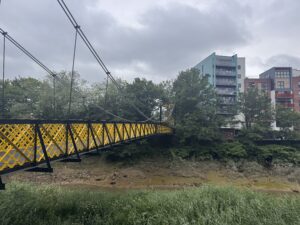 ark became less well used and a formal space. In May 1991, section was re-designated as a pocket park and wildlife have. They refurbished the rose garden and planted a wildflower meadow. However, the park suffered repeated arson attacks in the mid-1990s; the wooden sports pavilion was destroyed in August 1994, and a groundsman's hut used by Arnos Town Junior F.C. was burnt down in May 1995.
Sparke Evans Park Bridge renewed
A prominent feature of the park is the Sparke Evans Park Bridge, a suspension footbridge connecting the park on the north bank to the Paintworks development on the south bank. The bridge was built in 1933 by the Bristol engineering firm John Lysaght and Co. It was designed by David Rowell & Co of London, the same firm responsible for the design of the Gaol Ferry Bridge in Bristol The structure is a light steel suspension footbridge featuring steel basket balustrades. It measures 58 metres in length with a span width of 3.10 metres
By the early 2020s, the bridge had fallen into disrepair and the structure was prone to wobbling when crossed. The bridge was closed to the public on 30 October 2023 for a major restoration project, The restoration involved the removal of decking, masonry repairs, the repair of suspension cables and metalwork, and a full repaint.
Access improvements
While the structural restoration was largely completed on schedule for an October 2025 reopening, the ramp was deemed non-compliant with modern accessibility standards due to its steep gradient. This delayed the opening of the bridge.
Sparke Evans Park Bridge officially reopened to the public on Friday 22nd May 2026.