Joseph Goodale LansdownMedical Doctor & Mayor1812 to 1896
August 23, 2016
Thomas ProctorMedical Doctor & Mayor1812 to 1896
August 24, 2016
Charles Highett made a notable contribution to 19th century Bristol in several varied ways.
Early Life, Marriage and Medical Practice
Charles was born in the Carmarthenshire town of Kidwelly, South Wales, in 1812. Not much is known about his early life. He moved to Bristol in 1836 and married Elizabeth Holder Spencer in September 1839. Having undergoing medical training both as an apothecary and physician, he practised medicine as a general practitioner for 14 years in Stokes Croft, a needy part of the city. Initially he and his wife lived in North Street, St James but during the 1850s they moved to Field House, 113 Richmond Road in Montpelier. Charles lived there for the rest of his life.
Community Involvement
In 1850 Charles handed medical practice over to his brother. He then appears to have dedicated the rest of his life to voluntary activity. He was a member of the city’s Sanitary Committee. In October 1882 Bristol experienced 48 hours of continuous heavy rain. Several areas were flooded, including Broadmead, Baptist Mills, Bedminster, Stapleton Road and St Agnes. Conditions were particularly bad in Mina Road, where a baker delivering bread was swept away by the torrent and drowned. Highett and his niece were active in relieving distress in that district.
Highett was a Committee member of the Hooks Mill Orphanage Asylum, later known as Blue Maids because of the distinctive uniform of the children. This was a small orphanage for girls near the foot of Ashley Hill. It never rivalled the Muller Orphanages - situated further up Ashley Down - in size, income or fame, but it actually predated Muller’s initiative, opening in 1795. The Asylum Committee of which Highett was a member was diligent in monitoring standards and progress.
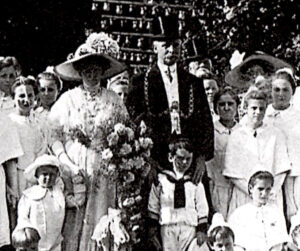
Highett as Mayor with Blue Maidss. He was also a member of the Library Committee and Director of the Bristol Gas company.
Highett’s contribution to the life of the city was recognised in 1891 when he served as Mayor for a year. He may well be the mayor seen in the photo of the Blue Maids which can be viewed in Bristol Records Office. He was said to be ‘of a kindly disposition, and by his personal qualities and readiness to undertake public duties, when he might well have elected to remain in retirement, he won the esteem of his fellow citizens’ (Clifton Society, 23 April 1896).

The Grave of Charles and Elizabeth Highett and their niece Matilda Alice Kirby
Death and Burial
Elizabeth died in September 1869 and was buried in Arnos Vale Cemetery. She and Charles had no children, but at some stage his niece Matilda Alicia Kirby joined him in living at Field House. During Charles’ year as Mayor Matilda carried out the social duties of the Mayoress,
and was much appreciated in that role. She had strong musical interests and for 12 years ran the Bristol and Clifton Musical Amateurs’ Society.
Charles lived 27 years as a widower. On his death in April 1896 he was interred with Elizabeth, the Committee for the Blue Maids Asylum paying tribute to him at his funeral. A third person in the grave is Matilda Alice Kirby, who was buried there in 1903. Their memorial is just inside the perimeter of Ceremonial Way opposite the Anglican Chapel.