Harry EdwardsSolicitor, Alderman1802 to 1881
October 12, 2026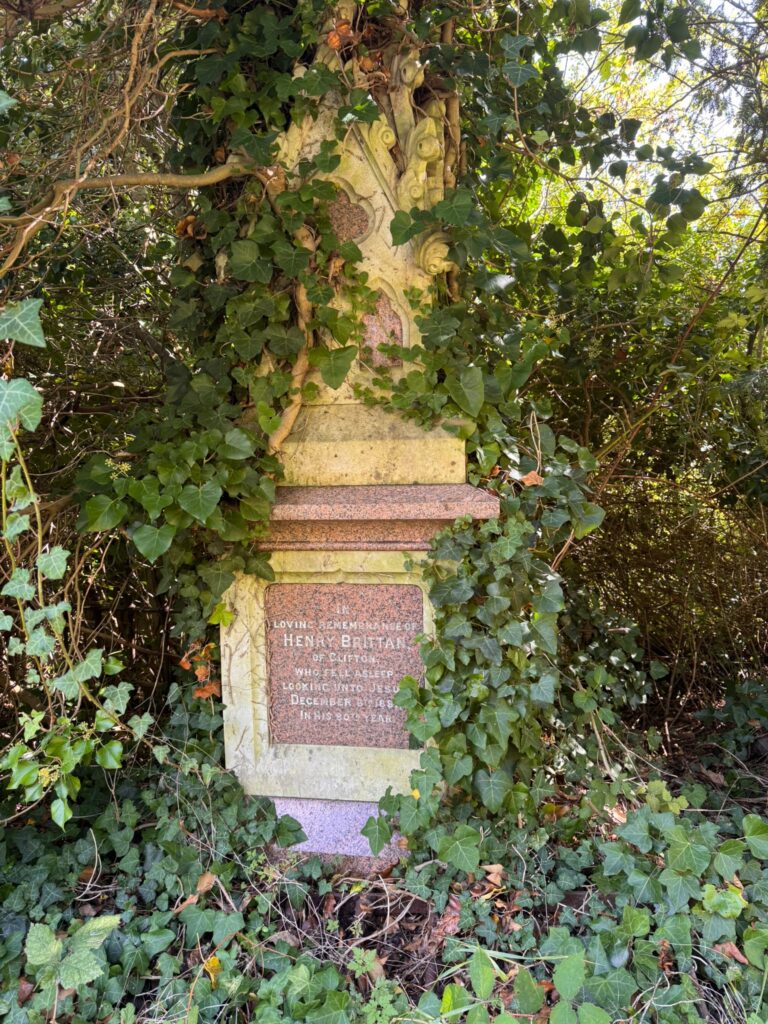
Henry Brittan (snr) was a successful commercial solicitor operating from offices in Small Street, Bristol. Initially working on his own, then in business with his son, he then went into successful partnership with 2 other lawyers forming Brittan, Press and Inskip.
He was an active member of Bristol society both commercially and socially. His legal prowess made him a popular choice as committee member and chair of various local organisations, businesses and charities.
Family Life:
He was born in Bristol on 21st July 1802. He was one of nine children born to Meshach Brittan (a currier - involved in the preparation of leather) and Sarah Wilks Standfast. His brother Meshach was also a successful Bristol solicitor.
After training in London for five years, he returned to Bristol and married Harriet Cross 20 December 1828. They lived the first few years of married life in St James Place, Kingsdown before moving to Chudleigh House, Whiteladies Road, Clifton where they lived for around 40 years.
They had three children, Henry born in 1831, Harriet Elizabeth born 1833 and Emmeline born 1838.
Henry (jnr), also a solicitor, worked alongside his Father until his sudden death in April 1872 at the age of 40. He was the first to be buried in the family grave at Arnos Vale, followed later by his parents.
Committees and Charities
His legal business brought him into contact with all sorts of commercial operations and individuals. As Bristol trade expanded and became more organised, he became a popular choice to join and chair the many committees overseeing business and charitable operations in the City. In his obituary in the Bristol Mercury, he was praised for “his clear headedness, business aptitude, and administrative powers”.
Among the organisations he served were:
Bristol Marine Board
Bristol Royal Infirmary
Young Men’s Christian Association
Bristol Blind Asylum (originally on the site of the Wills Memorial Building)
Bristol Seamen’s Friend Society
Railways
Bristol and Exeter Railway Company:
Henry was a legal advisor to the owners of the Bristol and Exeter Railway Company. In 1845 when the owners of the Great Western Railway were keen to purchase the Bristol and Exeter railway some of the Directors thought the deal being offered was unfair and detrimental to their interests. A special committee was formed to consolidate shareholder opinions and Henry was appointed secretary and legal advisor. The Bristol and Exeter Railway eventually amalgamated with the GWR in 1876.
Taff Vale Railway Company
In the last decade of his life, he was a Director and then Chairman of the Taff Vale Railway Company. The Taff Vale Railway opened and expanded in the 1840’s to provide vital transportation of coal and iron between Merthyr Tydfil and Cardiff. Throughout the latter half of the nineteenth century, it expanded opening various branch lines in South Wales and was eventually absorbed into the GWR in 1922.
It was a mark of the respect with which Henry Brittan was held that when he died in 1881, flags at Cardiff and other stations on the line were flown at half-mast.
Bristol and South Wales Wagon Company
Henry was a Director of the company which financed and leased rolling stock to railways.
Alderman
Henry served as an Alderman on the City Council for St Nicholas Ward for the last six years of his life.
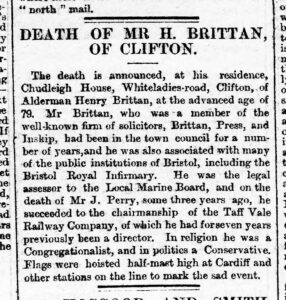
Brittan H Obituary Cardiff_Times_10_December_1881
Death
Henry Brittan died at his home, Chudleigh House, Whiteladies Road, Clifton on 6 December 1881 aged 79. In his will he left £45,810 13s 3d.
He was buried in the family grave at Arnos Vale Cemetery on 10 December 1881.
The Bristol Mercury reported: “The coffin was English oak, with solid brass furniture and was covered with a violet velvet pall, enriched with embroidery and fringe of white silk and it was conveyed to the cemetery in one of the newly introduced funeral cars”.
Harriet Brittan (his widow) died 20 December 1885 and was buried in the same grave as her son and husband.