Henry BrittanWW1 Poet who worked for GWR1874 to 1937
November 5, 2026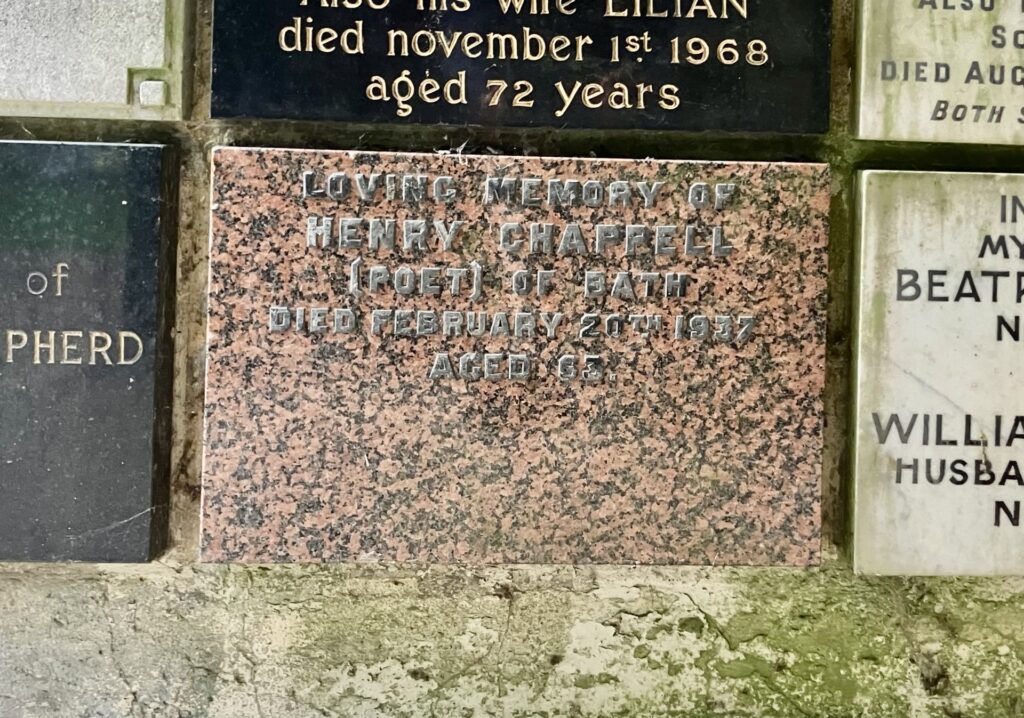
Early life
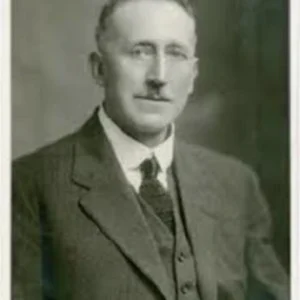
Born in London in 1874 to a shopkeeper father and a mother whose maiden name was Lang, Chappell came from a family originally rooted in Cornwall. In 1894, he married Edith Elizabeth Hancock.
Family life
By 1911, the couple had settled at 18 Park Avenue in Bath, Somerset, with their two daughters, Nellie Elizabeth (born 1896) and Alma Rose Edith (born 1899). Before achieving literary fame, Chappell made his living working as a porter at Bath Railway Station.
 The Day
 The Day
Chappell rose to sudden prominence following the outbreak of the First World War in August 1914 with his poem "The Day". The six-stanza work—which condemns the horrors of war and concludes with the biblical warning, "VENGEANCE IS MINE, I WILL REPAY"—was first published in the London Daily Express on 22 August 1914. It became an immediate international sensation, reprinted on broadsides and postcards as well as in newspapers across America, Canada, the Cape, and Australia. According to his great-granddaughter, Chappell generously donated all of the earnings from the poem to the Red Cross.
"The Day"
YOU boasted the Day, and you toasted the Day,
And now the Day has come.
Blasphemer, braggart and coward all,
Little you reck of the numbing ball,
The blasting shell, or the "white arm's" fall,
As they speed poor humans home.
You spied for the Day, you lied for the Day,
And woke the Day's red spleen.
Monster, who asked God's aid Divine,
Then strewed His seas with the ghastly mine;
Not all the waters of the Rhine
Can wash thy foul hands clean.
You dreamed for the Day, you schemed for the Day;
Watch how the Day will go,
Slayer of age and youth and prime,
(Defenceless slain for never a crime),
Thou art steeped in blood as a hog in slime,
False friend and cowardly foe.
You have sown for the Day, you have grown for the Day;
Yours is the harvest red.
Can you hear the groans and the awful cries?
Can you see the heap of slain that lies,
And sightless turned to the flame-split skies
The glassy eyes of the dead?
You have wronged for the Day, you have longed for the Day
That lit the awful flame.
'Tis nothing to you that hill and plain
Yield sheaves of dead men amid the grain;
That widows mourn for their loved ones slain,
And mothers curse thy name.
But after the Day there's a price to pay
For the sleepers under the sod,
And He you have mocked for many a day --
Listen, and hear what He has to say:
"VENGEANCE IS MINE, I WILL REPAY."
What can you say to God?
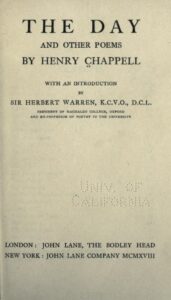
Although "The Day" brought him overnight recognition, Chappell was a prolific writer whose work appeared in eight First World War poetry anthologies. Alongside his breakthrough piece, he also gained recognition for poems such as "A Soldier's Kiss." In 1918, John Lane (The Bodley Head) published his debut collection, The Day, and Other Poems, in both London and New York, featuring an introduction by Sir Herbert Warren.
Death
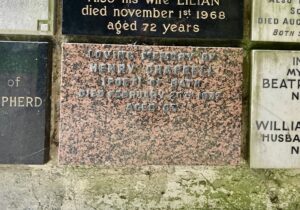 Henry died of suspected cancer on the 20th February 1937 in Bath, Somerset, England and was brought to Arnos Vale Cemetery for cremation and scattering. Following Henry's death, his widow, Edith Elizabeth Chappell (née Hancock) continued to live in Bath until her own death on 12 March 1951.